Brazil or Portugal?
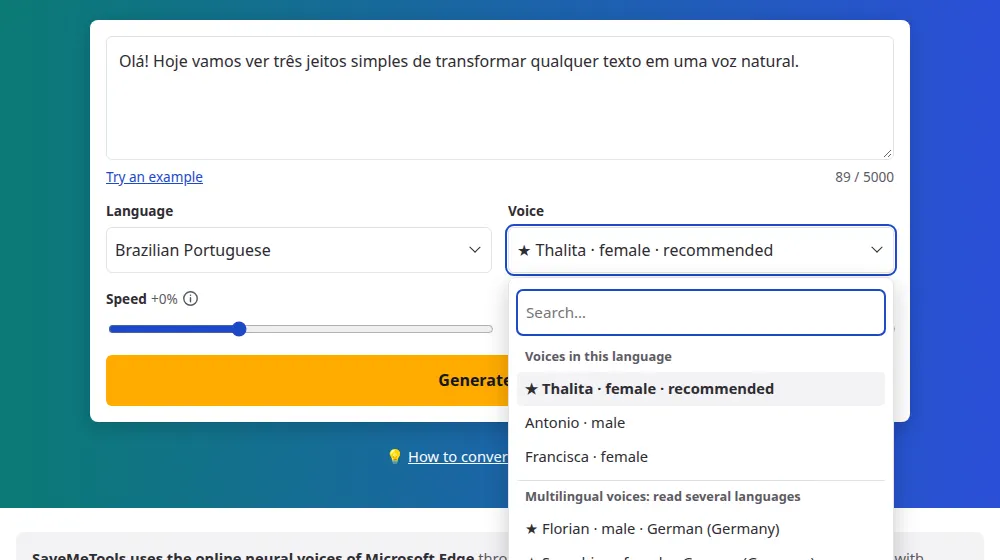
The two accents differ a lot in rhythm and vowels, and some words change completely. Brazilian voices, such as Francisca, Antonio and the multilingual Thalita, are the right choice for an audience in Brazil. Voices from Portugal, such as Raquel and Duarte, suit Portuguese and many African audiences better.
How to make audio in Portuguese
- Paste your Portuguese text in the box, with all its accents.
- Choose Brazilian Portuguese or European Portuguese in the language menu.
- Pick a voice and press Generate audio.
- Listen and download the MP3, or the subtitles in SRT and VTT.
Write it the way it should sound
Use the spelling of the accent you chose, and include all the accents: "secretária" and "secretaria" don't sound the same. Spell out abbreviations ("doutor" rather than "Dr.") when the voice stumbles, and write foreign names as they're pronounced.
For people creating content in Portuguese
In short videos, Thalita or Francisca at +5% speed tends to hold attention without sounding rushed. In lessons, Antonio at -5% gives students time to keep up. And don't forget to download the SRT subtitles, since many people watch with the sound off.
Speed and pitch in Portuguese
- Learning Portuguese: start at -25% and move up as you get used to it. Slowing down helps especially with voices from Portugal, where unstressed vowels are often barely heard.
- Narration: between -5% and +5% is a good starting point. Listen to a full paragraph before you decide, because the pace feels different in a long text.
- Pitch: if a voice sounds a little too high or too deep for your project, try up to 10 Hz either way before changing voices.
Frequently asked questions
Which Portuguese voice sounds best?
Thalita, marked ★, is the most recent voice for Brazil, and she usually sounds the most natural. For Portugal, try Raquel and Duarte. Test them all with a paragraph of your text, since the best choice depends on what you're making.
Does it handle accents and cedillas?
Yes. Write normally, with all the accents: it improves the pronunciation. Without them, the voice may read a word with the wrong stress or even as a different word, such as "sábia" and "sabia", which aren't said the same way.
How many Portuguese voices are there?
Five right now: Thalita, Antonio and Francisca for Brazil, and Raquel and Duarte for Portugal. Microsoft keeps the list and may change it. The voice list always shows what's available, along with each voice's style.
Should I use the voice from Brazil or from Portugal?
Use the one your audience speaks. The two accents differ a lot in sound and in some words, and listeners notice right away. Remember to adapt the text as well: a script written for Brazil may sound odd when read with a Portuguese accent.
Can Thalita read English words in a Portuguese text?
Yes, and she's the best choice for that, as voices marked ★ can read other languages. It works well for brand names and common terms. For the other voices, a foreign word may come out with a Portuguese pronunciation, so you may need to write it as it sounds.
How do I make numbers and abbreviations sound right?
Write them the way they should be read. Abbreviations in particular may be spelled out letter by letter, so use the full form when it matters. Do the same for currency, dates and phone numbers, then test a short sentence before generating the whole text.
Can I hear how a word is said in Brazil and in Portugal?
Yes. Generate the same text with a voice from Brazil and then with one from Portugal, and compare them. The difference is often in the vowels and in the final s, which sound quite different on each side of the Atlantic.